
The gasholder has an approved future. It is still on the at-risk register.
The Intelligence — August 2026
In January 2026, Hammersmith & Fulham Council approved the restoration of
Number 2 Gasholder at the former Fulham Gas Works. Built between 1829 and 1830,
it is the oldest surviving gasholder in the world, listed Grade II\*. Historic
England backed the scheme. Its regional director said the proposal would
"secure the long-term future of this unique piece of pioneering Georgian
engineering and allow its removal from our Heritage at Risk Register."
That was seven months ago. The gasholder is still on the register.
Not because anything has gone wrong. Because that is how the register works:
an entry is removed when the work is done, not when it is agreed. And
the work — dismantling a two-hundred-year-old wrought-iron frame, storing it,
and re-erecting it — is programmed to complete in time for the structure's
bicentenary in 2029.
Homes in the scheme are on sale now.
The belief this piece is arguing with
A regeneration site is understood, by almost everyone buying into one, as a
sequence with one uncertainty: will it finish on time. Consent is read as the
end of the argument. Once permission exists, the reasoning goes, what remains
is construction — a known process with a known duration.
That reading treats a planning approval as a completion. It is the single most
expensive assumption available to an off-plan buyer, because it collapses two
different things — the problem being solved on paper, and the problem being
finished on site — into one event, and then dates the event at the earlier of
the two.
What the register actually records
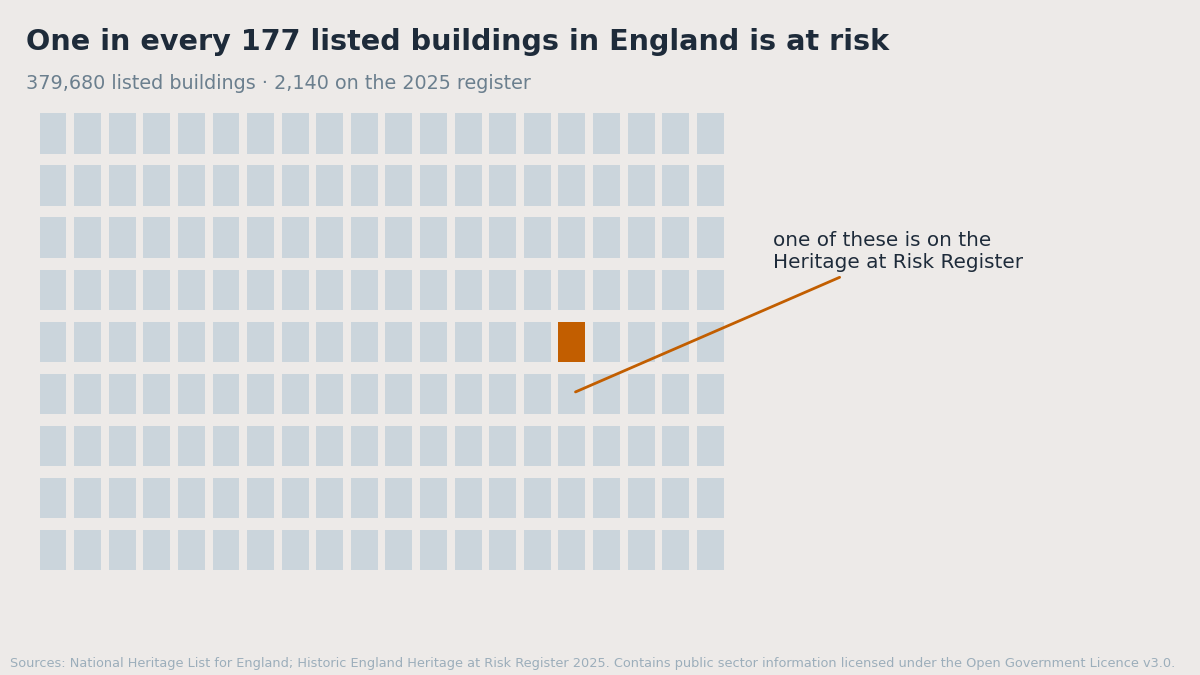
England has 379,680 listed building entries on the National Heritage List.
On the Heritage at Risk Register for 2025, 2,140 of those entries are listed
buildings — roughly one in every 177.
That number needs an explanation, because it will not match Historic England's
own headline, and a reader who checks should find the discrepancy explained
rather than discover it.
Historic England's published summary of the 2025 register counts 1,460
buildings or structures and 986 places of worship as separate categories,
alongside archaeology, parks and gardens, conservation areas, battlefields and
wreck sites — 4,891 entries in total. Those two headline categories do not map
onto "listed buildings". *Buildings or structures* includes structural
scheduled monuments, which are not listed buildings; *places of worship* are
listed buildings, but are reported on their own line.
Our 2,140 is a count taken from the register data itself, of entries whose
heritage category is Listed Building — which is the set that matches the
379,680 denominator. It is a different cut, not a different fact, and the ratio
only means anything because both sides of it are the same kind of thing. Read
against Historic England's 1,460, the denominator would be wrong.
One further disclosure: our copy of the register holds 4,837 entries for 2025
against the 4,891 in Historic England's summary. We have not reconciled the
54-entry gap and we are not going to present a figure as exact when we cannot
account for it. It bounds the ratio rather than breaking it: if every missing
entry were a listed building, one in 177 becomes one in 173. But you should
know it is there.
Two entries that sit on sites in our book
Number 2 Gasholder, Former Fulham Gas Works — Grade II\*, on the 2025
register. It is not next to the Fulham Gasworks scheme. It is inside it. A
consented restoration scheme now exists, backed by Historic England, targeted
at 2029.
St John's Smith Square Concert Hall — Grade I, on the 2025 register, in
SW1P, a few doors from Nobel House on Smith Square. Here too a solution is in
motion rather than absent: the venue is running a capital campaign to fund the
repairs. Also unfinished. Also still listed as at risk.
Two sites, two agreed directions of travel, two entries that remain on the
register. That is not a coincidence — it is the normal state of a heritage
asset between the decision and the delivery, and it is a state that can last
years.
Why the delivery risk survives the approval
Consent removes the largest question. It does not remove these three.
The heritage programme and the residential programme are not the same
programme. Dismantling, storing and re-erecting a listed structure is
governed by conditions and a legal agreement — in this case covering
dismantling, storage, reassembly, interpretation, public access and long-term
maintenance. Each of those is a gate that can move independently of the
residential phases being sold alongside it. Two schedules on one site do not
have to slip together, but they do have to fit together.
A second body now has standing for the duration. Historic England's
involvement does not end at approval; it continues through a programme of works
on a Grade II\* asset. That is a second counterparty with a view, and its view
applies for years after the permission is granted.
The cost of the heritage element is discovered late by construction. A
tower has a price per square metre. A wrought-iron frame from 1829 that is
taken apart and put back together has a survey, and then whatever the survey
finds. The consent fixes what will be done. It does not fix what will be found.
None of this makes the scheme a bad one. The Fulham gasholder is, on the public
record, a well-handled example: a developer that proposed a real solution, a
council that granted it, a national body that supports it. The point is
narrower and it survives all of that — a buyer's completion date lives
downstream of a heritage programme that has its own clock.
When the buyer finds out, and what to ask instead
Late — but the reason has changed.
The old failure was not knowing the register existed. That one is easy to fix
and mostly already fixed: the register is public, free and searchable by name.
The failure that remains is subtler. A buyer who checks the register today
finds Number 2 Gasholder listed as at risk and concludes there is an unresolved
problem. There is not — there is a resolved problem mid-delivery. A buyer who
reads the press release finds an approval and concludes the matter is closed.
It is not — it is scheduled. Both of the obvious checks return a misleading
answer, in opposite directions.
So the question to put to a seller is not "is there anything on the heritage
register here", which invites a yes or a no. It is:
*Is there a consented scheme for it, when does that scheme complete, and where
does my phase sit relative to it?*
The answer takes one sentence if they know their own site. The quality of that
sentence is the information.
The test, in four minutes
1. Search the National Heritage List for the site address and the streets that
bound it.
2. Check the same names against the Heritage at Risk Register.
3. If something comes back, search the developer's own news pages and the
council's planning portal for that structure by name — a consented scheme is
almost always announced, because it is good news for the developer.
4. Read the dates. Not the approval date: the completion date.
The rendering is a picture of the end state. The end state is real, and in this
case it is agreed and funded. The thing worth knowing is how long the middle
lasts, and whether you are buying into it.
---
*Correction, 9 August 2026: an earlier version of this piece, published on
7 August, stated that the Fulham gasholder's future had not been agreed. That
was wrong. Hammersmith & Fulham Council approved a restoration scheme in
January 2026, publicly reported at the time and supported by Historic England.
The piece has been rewritten around the sequencing risk that remains rather
than a resolution that does not. We have also added an explanation of how our
2,140 figure relates to Historic England's published categories, and disclosed
a 54-entry difference between our copy of the register and the published
summary. The error was ours: our checks re-verified the arithmetic and never
asked whether the situation the arithmetic described was still current.*
*Sources: National Heritage List for England (379,680 listed building entries);
Historic England Heritage at Risk Register 2025 (2,140 listed building entries;
4,891 entries in total across all categories, comprising 1,460 buildings or
structures, 986 places of worship, 1,864 archaeology entries, 469 conservation
areas, 105 parks and gardens, 4 protected wreck sites and 3 battlefields),
both accessed August 2026. Approval of the Gasholder No.2 restoration at King's
Road Park, Hammersmith & Fulham Council, reported 27–29 January 2026; statement
by Historic England quoted from the developer's announcement of 28 January 2026.
Individual register entries: Number 2 Gasholder, Former Fulham Gas Works,
Imperial Road, Grade II\* (list entry 1261959); St John's Smith Square Concert
Hall, Smith Square SW1, Grade I (list entry 1236250).*
*Contains public sector information licensed under the Open Government Licence
v3.0.*
Questions and answers
Why is a building still on the Heritage at Risk Register after its restoration was approved?
Because an entry leaves the register when the work is done, not when it is agreed. Approval changes the plan; the register records the condition of the fabric.
How many listed buildings are there in England, and how many are at risk?
379,680 listed buildings, of which 2,140 are on the 2025 Heritage at Risk Register. Both figures are recomputed by us from the National Heritage List and the register itself.
Does an approved scheme reduce the risk on a heritage site?
It reduces planning risk, not delivery risk. Dismantling, storing and re-erecting a two-hundred-year-old wrought-iron frame is programmed work, and the register keeps recording the building until that work is finished.
Sources
- Historic England — National Heritage List for England (Open Government Licence v3.0)
- Historic England — Heritage at Risk Register 2025 (Open Government Licence v3.0)
Methodology
The two counts in this piece are recomputed by us from the raw registers, not taken from a published summary. Listed buildings: the National Heritage List for England, entries where the asset is a listed building — 379,680. At risk: the Historic England Heritage at Risk Register, 2025 edition, entries in the Listed Building category — 2,140. Both recomputed on 9 August 2026. Both datasets are published under the Open Government Licence v3.0, which is why the figures can appear here in full.
One limit worth stating: the register records a building's condition at the moment of publication. An entry that has since been repaired is still listed until the next edition, and an entry approved for repair — like this one — stays until the work is finished.
Frequently asked questions
Why is a building still on the Heritage at Risk Register after its restoration was approved?
Because an entry leaves the register when the work is done, not when it is agreed. Approval changes the plan; the register records the condition of the fabric.
How many listed buildings are there in England, and how many are at risk?
379,680 listed buildings, of which 2,140 are on the 2025 Heritage at Risk Register. Both figures are recomputed by us from the National Heritage List and the register itself.
Does an approved scheme reduce the risk on a heritage site?
It reduces planning risk, not delivery risk. Dismantling, storing and re-erecting a two-hundred-year-old wrought-iron frame is programmed work, and the register keeps recording the building until that work is finished.