
One number carries the whole of London's year, and it is not a price.
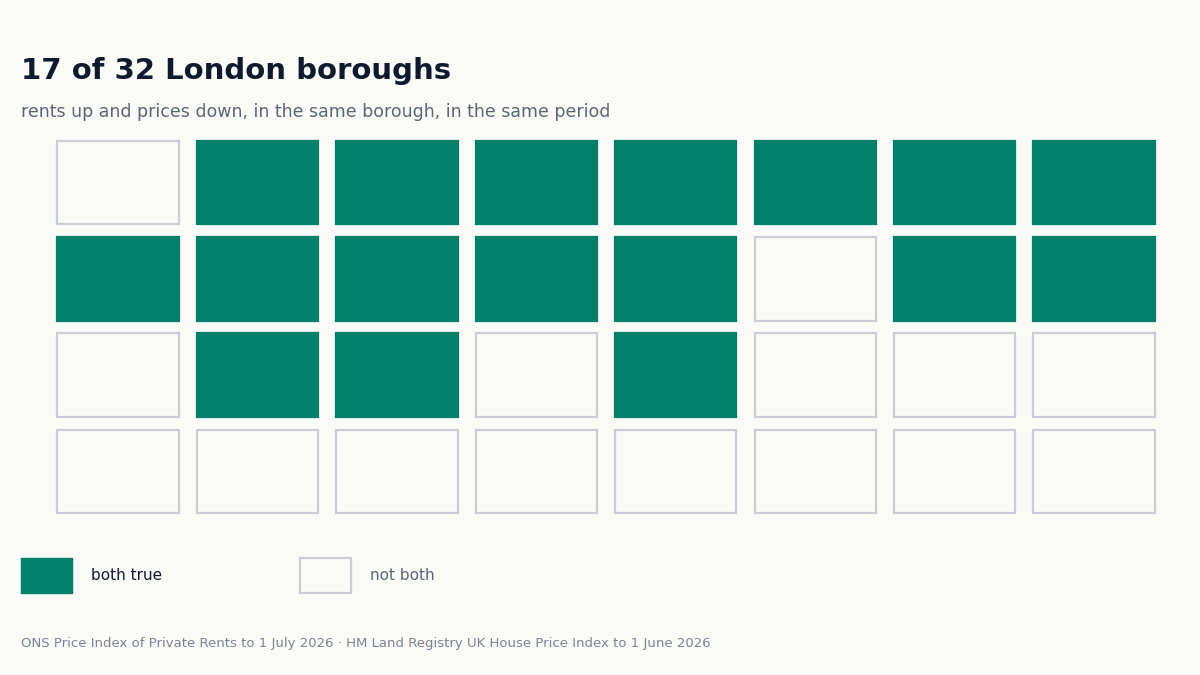
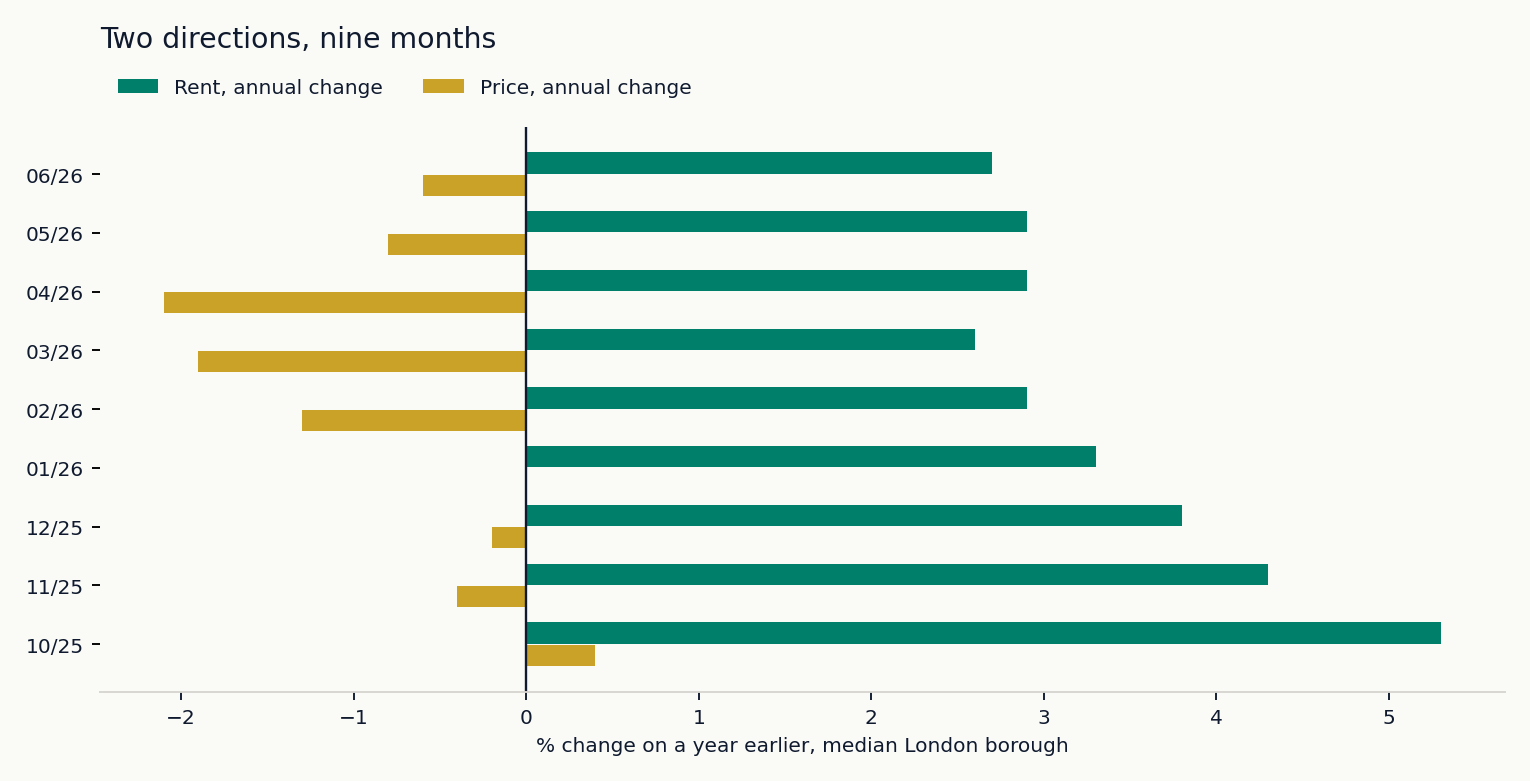
Across the 32 London boroughs with both official series, the median borough saw rents 2.7% higher than a year earlier and prices 0.6% lower. In 17 of 32 boroughs both were true at once — rent up and price down, in the same borough, in the same period.
That has an arithmetic consequence rather than an opinion attached to it. Gross rental yield in the median London borough moved from 6.01% a year ago to 6.34%, up 0.33 of a percentage point. Yields are rising across London. In more than half of it they are rising because the denominator is falling.
London in five figures
| Measure | Latest | Source and vintage |
|---|---|---|
| Rent, annual change, median borough | +2.7% | ONS Price Index of Private Rents, 1 July 2026 |
| Price, annual change, median borough | -0.6% | HM Land Registry UK HPI, 1 June 2026 |
| Boroughs with rent up and price down | 17 of 32 | both series, same period |
| Boroughs with rent up on the year | 30 of 32 | ONS Price Index of Private Rents, 1 July 2026 |
| Gross yield, median borough | 6.01% → 6.34% | rent over price, before costs |
*The gross yield combines a rents figure to 1 July 2026 with a prices figure to 1 June 2026 — the latest month available for each series.*
Why a rising yield is not automatically good news
A yield can rise two ways: the rent goes up, or the price comes down. They are not the same investment.
Rent rose in 30 of the 32 boroughs over the year, so the numerator is doing real work. But rent growth is also decelerating, and a yield built on rent growth that is slowing has a shorter runway than the number suggests. Where the yield rose because the price fell, the same figure describes a different position entirely.
Read the full report
The report sets out the split borough by borough, with the methodology and the vintage of every series stated before the figures. It is free to read, in English and Italian, on Capital View.
Methodology
- Prices — HM Land Registry UK House Price Index, latest month 1 June 2026.
- Rents — ONS Price Index of Private Rents, latest month 1 July 2026.
- Statistic — the median London borough, and it is labelled as a median wherever it appears. Where an average is used it says average.
- What this does not cover — the oldest figure here is from 1 June 2026. Anything that happened in London since then is not in this piece, and this piece cannot tell you it did not happen.
FAQ — Questions and answers
Are London rents still rising in 2026?
Yes, but more slowly. In the median London borough rents were 2.7% higher than a year earlier on the ONS Price Index of Private Rents to 1 July 2026, and rent rose in 30 of the 32 boroughs with both series. The rate of increase has come down through the year.
Are London property prices falling?
In the median borough, slightly: 0.6% lower than a year earlier on the HM Land Registry UK House Price Index to 1 June 2026. It is a shallow move, not a correction, and it is not uniform — the direction differs borough by borough.
What is the gross rental yield in London now?
6.34% in the median London borough, against 6.01% a year earlier. That is a gross figure: it is rent over price, before costs, voids and tax.
Why does it matter whether a yield rose because rent went up or price went down?
Because the two describe different positions. A yield lifted by rent reflects demand for the property. A yield lifted by a falling price reflects a smaller denominator, and the capital position behind it is weaker. In 17 of 32 boroughs both happened at once.
Sources
- HM Land Registry — UK House Price Index (Open Government Licence v3.0)
- Office for National Statistics — Price Index of Private Rents
Frequently asked questions
Are London rents still rising in 2026?
Yes, but more slowly. In the median London borough rents were 2.7% higher than a year earlier on the ONS Price Index of Private Rents to 1 July 2026, and rent rose in 30 of the 32 boroughs with both series. The rate of increase has come down through the year.
Are London property prices falling?
In the median borough, slightly: 0.6% lower than a year earlier on the HM Land Registry UK House Price Index to 1 June 2026. It is a shallow move, not a correction, and it is not uniform — the direction differs borough by borough.
What is the gross rental yield in London now?
6.34% in the median London borough, against 6.01% a year earlier. That is a gross figure: it is rent over price, before costs, voids and tax.
Why does it matter whether a yield rose because rent went up or price went down?
Because the two describe different positions. A yield lifted by rent reflects demand for the property. A yield lifted by a falling price reflects a smaller denominator, and the capital position behind it is weaker. In 17 of 32 boroughs both happened at once.