
Investors who confuse headlines with long-term fundamentals often make expensive decisions. The £3,100 one-bedroom headline at Elephant Quarter is a case study in exactly that.
It is the late-stage output of a long regeneration sequence: estate decline, decanting, land transfer, viability arguments, overseas off-plan sales, and finally a new rental product marketed with concierge-led amenities at central-London prices. The useful question for investors is not simply whether £3,100 is fair, but what the sequence reveals about urban regeneration, capital flows, pricing behaviour and the danger of reading London through one symbolic headline.
Timeline
| Year | Event | Why it matters |
|---|---|---|
| 2006 | Southwark began decanting the Heygate Estate (Southwark Council; 35% Campaign timeline). | Regeneration started with resident displacement long before the current rent controversy. |
| 2011-2014 | Demolition proceeded on the Heygate's 1,212 homes, 1,020 of them council-owned (Southwark Council). | The stock removed was overwhelmingly social housing, changing the area's tenure mix at source. |
| 2013 | Southwark granted Lendlease a long lease over the roughly 10-hectare site, remaining freehold owner; land terms were reported at about £50m, after roughly £44m had been spent decanting residents (Southwark Council; reporting by Vice). | A large public asset was repositioned after heavy public decanting costs. |
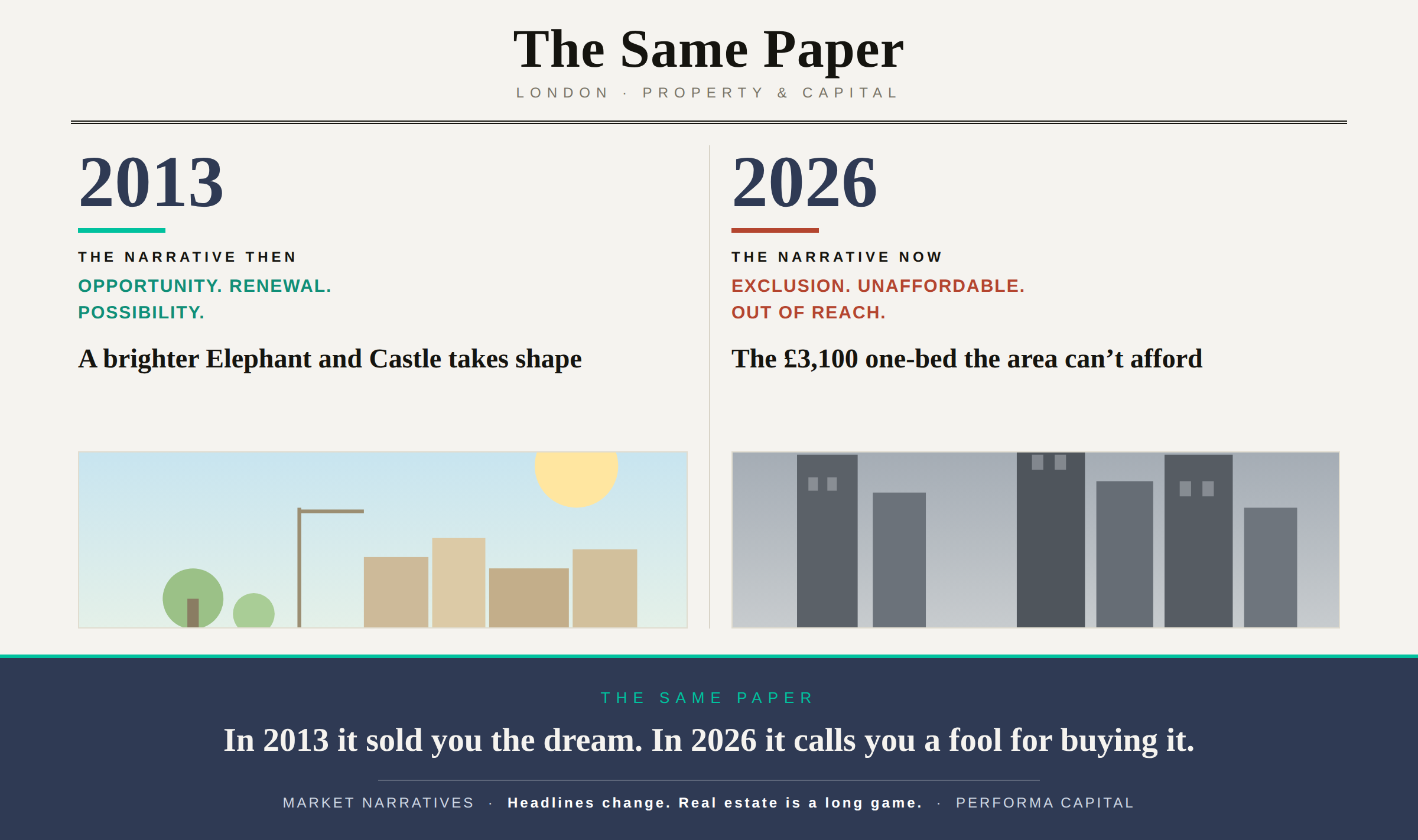
| 2013 | The Telegraph framed the scheme as "Elephant and Castle's transformation", highlighting an eco-friendly mixed-use future (The Telegraph, October 2013). | The same process could be told as visionary regeneration when the emphasis was renewal, not affordability. |
| 2015 | Campaigners (35% Campaign) argued Lendlease's viability case had been used to cut affordable-housing obligations; the redacted assessment was released only after a multi-year FOI battle. | Viability became the lever shaping the social outcome. This is the campaigners' reading, contested by the developer. |
| 2017 | Transparency International's "Faulty Towers" report found an early phase (South Gardens) sold all 51 of its first flats to overseas investors (Transparency International; Land Registry). | Capital flows, not only local owner-occupier demand, drove how replacement stock was absorbed. |
| 2024 | The final-phase plot, still empty, was sold off-market to HUB and HIG for £42m (IPE Real Assets; BE News; Lendlease). Campaigners note that is about seven times the £6m paid under the original agreement. | Long cycles can generate large land-value uplift even when promised social outcomes stay thin. |
| 2026 | The Telegraph reported Elephant Quarter rents of £2,610 (studio), £3,100 (one-bed) and £5,010 (three-bed); prices were then removed from the website after inquiries. | The late-stage output of the regeneration became a national affordability symbol. |
From decline to redevelopment
The Heygate Estate contained 1,212 homes, 1,020 of them council-owned, on land owned by Southwark Council. By the early 2010s, political support for demolition had hardened around a familiar urban-regeneration script: old estate stock was framed as a symbol of neglect, and replacement development as modernisation.
That framing mattered because it defined the sequence that followed. Southwark began decanting residents in 2006, demolition ran from 2011 to 2014, and the council granted Lendlease a long lease over the site, retaining the freehold, on land terms reported at about £50m after roughly £44m had already been spent moving residents out. The decisive moment was not the later rent headline. It was the point at which a large social-housing asset was cleared and repositioned for a different capital structure and a different resident base.
The economics of the new scheme
The replacement development, Elephant Park, delivered roughly 2,924 homes, of which only 100 are social rent, 92 on the main site plus 8 on the adjacent first phase, Trafalgar Place (Southwark planning records and a council Freedom of Information response; reported by Estates Gazette). That shift in tenure mix is the core economic fact behind the current controversy: a district once anchored by council housing was rebuilt around a much more financialised housing model.
The new Elephant Quarter product sits squarely inside that model. The Telegraph reported a 485-home development with concierge, gym, dog-play area and co-working space, with asking rents of £2,610 for studios, £3,100 for one-beds and £5,010 for three-beds before the prices were removed from the site. This is not simply housing in the abstract. It is a central-London, amenity-led rental product designed to capture a tenant mix that can absorb service-rich, professionally managed rents.
What the Telegraph headline leaves out
The 2026 Telegraph article captures the shock value of the new rents but leaves out much of the sequence that produced them. It reports the current pricing, the political outrage, the below-market commitments and the viability pressure, but it does not reconstruct the longer chain running from decanting and land disposal to affordable-housing compression and overseas off-plan absorption.
The omissions matter because they change the implied story. Without that background, £3,100 reads as a sudden moral failure. With that background, £3,100 reads as a predictable late-stage output of a twenty-year reallocation of land, tenure and target customer.
Missing context: Telegraph versus the broader record
| Question | What the 2026 Telegraph piece says | What the broader record adds |
|---|---|---|
| What is being priced? | A 485-home Elephant Quarter build-to-rent development with concierge, gym, dog area and co-working space. | The rent product sits within a regeneration arc that replaced the Heygate's 1,212 homes. |
| How high are the rents? | Studios at £2,610, one-beds at £3,100, three-beds at £5,010. | The pricing became controversial after publication, but the deeper significance lies in the tenure shift that preceded it. |
| What happened after scrutiny? | Prices were removed from the website after Telegraph inquiries. | The withdrawal shows the reputational sensitivity of the product once it became a political symbol. |
| How much social housing was lost and replaced? | The article notes 35% below-market homes in Elephant Quarter and 165 additional affordable homes promised nearby. | Across the wider Elephant Park scheme, 1,212 homes were replaced by roughly 2,924, but only 100 are social rent (Southwark FOI; Estates Gazette). |
| How did capital enter the scheme? | The article focuses on current rents and local criticism. | An early phase sold all 51 of its first flats to overseas investors (Transparency International; Land Registry). |
| What was the earlier media frame? | The 2026 article calls the area a symbol of what has gone wrong with London housing. | In 2013, the same paper framed Elephant & Castle as a transformation and highlighted eco-friendly mixed-use renewal (The Telegraph, October 2013). |
Urban-regeneration impact
The economic impact of the regeneration can be read across four levels.
1. Land-value uplift
Once a large estate is decanted, cleared and replanned at higher density, land values can rise sharply. The final-phase plot was sold off-market for £42m in December 2024, which campaigners put at about seven times the £6m paid for that plot under the original partnership agreement. That does not by itself prove bad planning, but it shows how regeneration often converts public-land restructuring into private-value uplift over long timescales.
2. Tenure transformation
The most important structural change is not aesthetic but tenurial. A council-housing base was replaced by a mixed scheme with a much smaller social-rent component and a much larger exposure to private capital and market pricing. That makes later affordability shocks less mysterious: once the tenure architecture changes, the pricing logic changes with it.
3. Demand re-segmentation
A concierge-led tower with co-working space, gym and pet amenities does not target the median local wage earner in any ordinary sense. It targets a narrower but deeper pool: corporate renters, internationally mobile tenants, households subsidised by parental capital, and residents willing to pay for management quality and centrality. The controversy partly arises because the public debate describes this product as if it had been built for the headline's average worker, when the feature set points to a different target segment entirely. For scale, average earnings in London in May were £3,082 a month (ONS); the one-bed asks almost exactly one full average local salary in rent alone.
4. Narrative volatility
The same place can be sold as visionary renewal in one cycle and condemned as London's housing failure in the next (The Telegraph, 2013 and 2026). Even the 2026 "concrete hell" epithet was recycled: it originally described the area's 1960s concrete, not the new towers. For investors, that volatility matters economically because headlines move political attention, local sentiment, reputational risk, and the willingness of outside capital to tell one scheme, one district and one segment apart from the whole London market.
What investors should take from this
For investors, the Elephant & Castle case is valuable precisely because it is not only a morality tale. It is a lesson in how pricing emerges after a long chain of planning, tenure, land and narrative decisions.
First, regeneration should be analysed from the starting tenure mix forward, not from the finished rent backward. If social-rent stock is removed and replacement supply is built for professionally managed private occupancy, higher market rents are an expected outcome, not a surprise.
Second, the right question is not whether a headline rent is offensive, but what demand base the product is built for, and how resilient that base is under scrutiny. Prices were pulled after media inquiries, which shows pricing can become politically charged even when it broadly reflects a segment's market logic.
Third, investors should resist writing off an entire city because one symbolic scheme becomes a national talking point. Elephant & Castle is a lesson in segmentation: districts, products and capital structures need to be separated, not collapsed into one London-wide verdict.
London is no longer bought by postcode. It is bought by strategy.
Questions and answers
Is the £3,100 one-bed in Elephant and Castle overpriced?
It depends entirely on who it was built for. At roughly one full average London monthly salary (£3,082, ONS, May 2026), it is plainly not aimed at the average local worker. The real question is whether the corporate and international tenants it was designed for exist in enough depth at that price and location.
What is the difference between product London and prime London?
Product London is new-build, amenity-led stock sold primarily on yield, whose demand can be thin and cycle-sensitive. Prime London is established stock with older, deeper, more diversified demand that tends to survive full market cycles. They are different assets, not different price points of the same thing.
Has this happened in Elephant and Castle before?
Yes, on the adjacent land. The Heygate Estate, 1,212 mostly council homes, was emptied from 2006, demolished by 2014, and replaced by Elephant Park, roughly 2,924 homes of which only 100 are social rent (Southwark planning records and FOI; Estates Gazette). An early phase sold all 51 of its first flats to overseas investors (Transparency International; Land Registry).
Should international investors avoid London because of stories like this?
No, the lesson is the opposite. A single product-led scheme priced beyond local wages is not evidence that London is finished. It is evidence of why the durable, diversified parts of the market must be told apart from the cycle-sensitive product around them.
What does bought by strategy, not by postcode mean?
It means choosing London exposure on the strength and durability of demand, liquidity and legal stability, rather than on a postcode, a brochure or a render. It is a capital allocation decision, not a lifestyle one.
Methodology
- What this piece is. A reconstruction of a published record, not new measurement. Every figure below is attributed in the text to the body that produced it, and none of them is ours.
- The spine of the account is Southwark Council's own planning record and a council response to a Freedom of Information request, reported by Estates Gazette: 1,212 Heygate homes, 1,020 of them council-owned, replaced by roughly 2,924 homes of which 100 are social rent.
- The rent figures are as reported by The Telegraph in 2026, before the prices were removed from the developer's website. We have not independently verified them and they cannot now be checked at source.
- The salary comparison uses ONS average earnings for London, May 2026.
- Contested readings are labelled as such. The viability argument is the 35% Campaign's reading and is disputed by the developer; the overseas off-plan finding is Transparency International's, in *Faulty Towers* (2017). Their own publications are named in the text rather than listed as sources, because we link only to addresses we have opened ourselves.
- What we do not claim. No forecast is made about rents, values or the scheme's future.
Sources
- Southwark Council — planning and building control record
- Office for National Statistics — earnings and working hours
Frequently asked questions
Is the £3,100 one-bed in Elephant and Castle overpriced?
It depends entirely on who it was built for. At roughly one full average London monthly salary (£3,082, ONS, May 2026), it is plainly not aimed at the average local worker. The real question is whether the corporate and international tenants it was designed for exist in enough depth at that price and location.
What is the difference between product London and prime London?
Product London is new-build, amenity-led stock sold primarily on yield, whose demand can be thin and cycle-sensitive. Prime London is established stock with older, deeper, more diversified demand that tends to survive full market cycles. They are different assets, not different price points of the same thing.
Has this happened in Elephant and Castle before?
Yes, on the adjacent land. The Heygate Estate, 1,212 mostly council homes, was emptied from 2006, demolished by 2014, and replaced by Elephant Park, roughly 2,924 homes of which only 100 are social rent (Southwark planning records and FOI; Estates Gazette). An early phase sold all 51 of its first flats to overseas investors (Transparency International; Land Registry).
Should international investors avoid London because of stories like this?
No, the lesson is the opposite. A single product-led scheme priced beyond local wages is not evidence that London is finished. It is evidence of why the durable, diversified parts of the market must be told apart from the cycle-sensitive product around them.